Does Fasting Slow Metabolism? What Science Really Says
Does Fasting Slow Metabolism? What Science Really Says
One of the most common fears around fasting is this question: does fasting slow metabolism? Many people avoid fasting because they believe it damages their metabolic rate permanently. But science shows a very different picture. Fasting doesn’t “break” metabolism; it temporarily changes how the body produces energy.
Understanding this distinction is key to using fasting correctly for fat loss and metabolic health.
What Happens to Metabolism When You Start Fasting?
When fasting begins, the body initially relies on stored carbohydrates. Liver glycogen supplies glucose for the first 24–48 hours. During this phase, carbohydrate metabolism slows down, which many people mistake as an overall metabolic slowdown.
However, this is not metabolic damage. As insulin levels fall, the body switches fuel sources. Burning fat during fasting increases, as fatty acids are released and converted into ketone bodies. So while carb usage decreases, fat metabolism accelerates.
This fuel shift is a survival mechanism not a metabolic failure.
When Does the Body Start Burning Fat During Fasting?
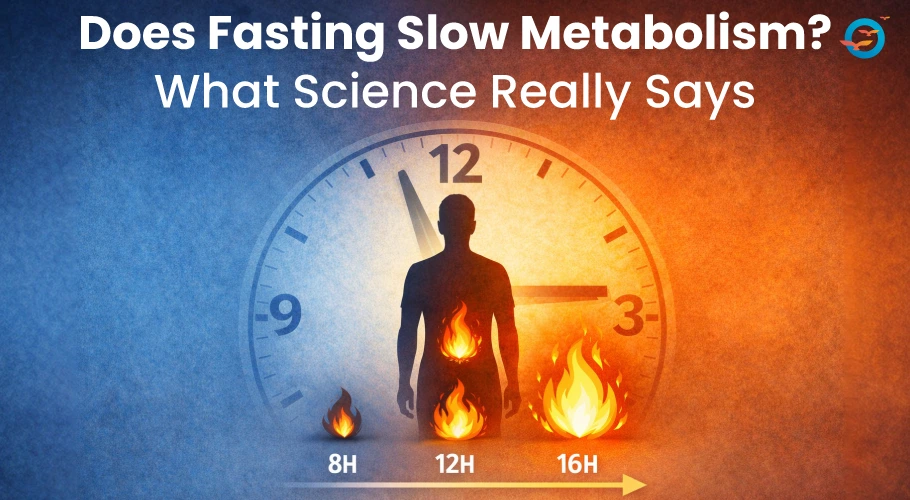
A common question is when does the body start burning fat during fasting? Fat burning doesn’t start immediately. It increases after glycogen stores are depleted, usually between 12 and 48 hours depending on muscle mass, activity level, and prior diet.
This explains why short fasting windows may not show instant fat loss. Burning fat during fasting is a gradual metabolic transition, not an on–off switch.
Does Fasting Slow Down Metabolic Rate or BMR?
Research shows that during longer fasts, basal metabolic rate (BMR) may decrease by about 5–15%. This leads to concerns like “does intermittent fasting reduce BMR?”
The key point: this reduction is temporary.
Once eating resumes, metabolism rebounds. Problems arise only when fasting is prolonged, frequent, and poorly structured especially if it causes muscle loss. Muscle is metabolically active tissue, and losing it can lower long-term energy expenditure.
So the real risk is not fasting itself, but unplanned fasting without muscle preservation.
Does Fasting Increase Metabolic Rate?
Short-term fasting does not dramatically increase metabolic rate, but it improves metabolic flexibility & the body’s ability to switch between glucose and fat efficiently. Lower insulin levels during fasting support fat breakdown, which is why fasting helps fat loss even without strict calorie counting.
This hormonal shift is far more important than calorie math alone.
How Many Calories Do You Burn While Fasting?
People often ask, how many calories do I burn while fasting? The answer depends on your BMR, muscle mass, age, and activity level. Even during fasting, your body continues burning calories to support vital functions.
Fasting doesn’t stop calorie burn. It simply changes where the calories come from shifting energy usage toward stored fat when insulin is low.
Is Metabolism Slowdown After Fasting Permanent?
No. Metabolism slowdown from fasting is not permanent when fasting is short-term, structured, and followed by proper nutrition. Long-term issues occur only when fasting is done incorrectly, for too long, or without adequate protein and muscle support.
Used correctly, fasting enhances metabolic efficiency rather than damaging it.
FAQs
1. Does fasting slow metabolism?
Fasting may temporarily reduce metabolic rate during extended fasts, but this effect is reversible and not permanent.
2. Does fasting slow down metabolic rate?
Yes, short-term metabolic slowdown can occur, but metabolism recovers once normal eating resumes.
3. Does fasting increase metabolic rate?
Fasting improves fat metabolism by lowering insulin, though overall metabolic rate remains largely stable.
4. Does intermittent fasting reduce BMR?
Intermittent fasting does not significantly reduce BMR when practiced correctly and for limited durations.
5. How intermittent fasting affects your metabolism?
It shifts the body from glucose dependence to fat utilization, improving metabolic flexibility.
6. When does the body start burning fat during fasting?
Fat burning increases once glycogen stores are depleted, usually within 12–48 hours.
7. When do you burn fat during intermittent fasting?
Fat burning occurs mainly during fasting windows when insulin levels are low.
8. How many calories do I burn while fasting?
Calorie burn continues during fasting and depends on your basal metabolic rate and muscle mass.
9. Is metabolism slowdown permanent after fasting?
No. Any slowdown is temporary and reversible with proper refeeding and muscle preservation.
10. How does fasting affect insulin and fat burning?
Fasting lowers insulin, allowing stored fat to be released and used as energy.