Waist-to-Height Ratio vs BMI: Which Better Detects Diabetes and Health Risks?
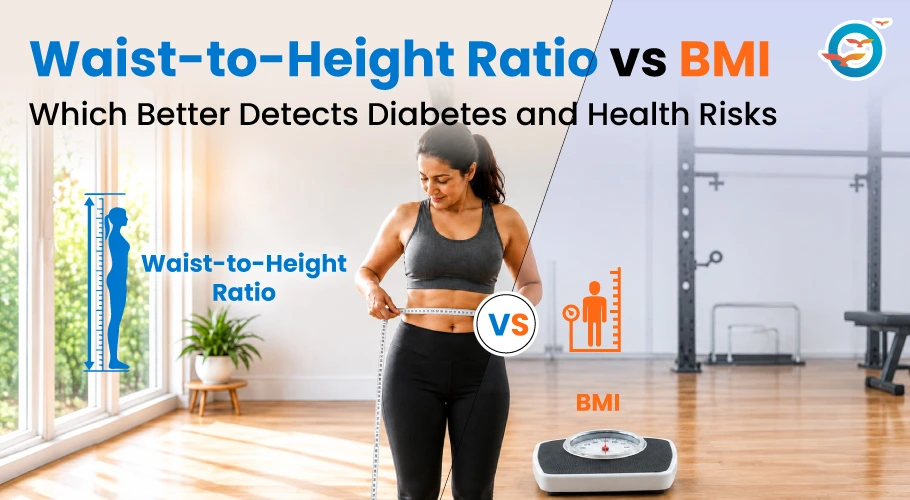
Waist-to-Height Ratio vs BMI: Which Predicts Diabetes Risk?
You know the feeling!
You step on the scale after a month of trying to eat better, only to see the number hasn't gone down. Meanwhile, your favourite pair of trousers feels suspiciously tighter around the waist.
Isn’t it frustrating?
We have all been deeply interested in Body Mass Index (BMI), thinking that it is the best measure of our health. Yet have you ever come across a person who has a "normal" BMI and appears entirely fit on paper and yet is still suffering from high blood sugar or high blood pressure?
That is precisely the reason why we should consider factors other than body size. A better and more accurate measure exists which could alter the way you see your health: the waist-to-height ratio (WHtR).
What Is Waist-to-Height Ratio?
WHtR is a figure that helps assess how body fat is distributed, especially around the waist; to calculate it, you divide your waist circumference by your height.
For instance, if your height is 170 cm and your waist size is 85 cm:
WHtR = 85 ÷ 170 = 0.5
If you'd like to know how to calculate your waist-to-height ratio, that's exactly what you need to do. Or else you can use an online waist-to-height ratio calculator to obtain quick and easy results.
It is a practical and accurate method that enables you to find out your body shape and health risks from the comfort of your own home; unlike BMI, this height-to-waist ratio shows you where fat is stored in the body.
Waist-to-Height Ratio vs BMI
As mentioned earlier, BMI is the ratio of your weight to your height; it is a popular and widely used method for assessing whether a person is within a healthy weight range.
A major drawback of the body mass index is that it considers only weight and height, ignoring where the fat is stored. Moreover, BMI cannot tell the difference between lean muscle mass and body fat.
This is why many experts see WHtR as a useful alternative to BMI when assessing metabolic health risks.
What is particularly valuable is that abdominal fat is a strong indication of a number of chronic disorders, including Type 2 diabetes, hypertension, and high cholesterol. As a result, when the waist circumference is compared with the BMI, the waist measurement usually provides a more accurate show of an individual's health risks than does weight alone.
Why WHtR May Predict Diabetes Risk Better?
If there is a family history of diabetes or if you have any worries about fatty liver, then you should watch your waist. Abdominal fat and insulin resistance go hand in hand, and when your waist grows bigger it is usually a physical indication that your body is having difficulty in managing blood sugar effectively.
Waist circumference and disease risk are tightly linked because that central fat interferes with how your liver and pancreas function. By focusing on your WHtR, you are monitoring your metabolic health in real-time, catching significant issues long before they show up on a standard blood report.
What's a Normal Waist-to-Height Ratio?
The golden rule is to keep your waist circumference to less than half of your height. A healthy waist-to-height ratio is generally considered to be 0.5 or less. If your ratio is higher than 0.5, it’s a gentle wake-up call to focus more on your nutrition and physical activity to bring that number back into a safer range.
To Sum Up
Perhaps you shouldn't get rid of your weighing scale just yet, but you should stop letting it control your whole health narrative. Begin measuring your waist as well. The waist-to-height ratio gives you a far better indication of your internal health. For people in the age group of 35 to 65, this simple and minor measurement could end up being the most important habit that you begin this year.
Want to know more about understanding Body Mass Index (BMI)? Visit our blog to learn more.
FAQs
1. What is the ideal waist-to-height ratio?
Most research suggests keeping your waist circumference below half your height, which means maintaining a waist-to-height ratio below 0.5.
2. Can waist-to-height ratio detect obesity risk earlier?
Yes. Studies suggest WHtR can identify excess abdominal fat and cardiometabolic risk even when BMI falls within the normal range.
3. Can waist-to-height ratio predict diabetes risk?
Research indicates that WHtR is often a stronger predictor of diabetes risk than BMI because it reflects central fat accumulation, which is closely linked to insulin resistance.
4. Can someone have a normal BMI but still have health risks?
Absolutely. A person can have a normal BMI but excess visceral fat around internal organs, increasing the risk of diabetes, fatty liver disease, and heart disease.
5. How can I reduce my waist-to-height ratio naturally?
Regular exercise, strength training, quality sleep, stress management, and a diet focused on whole foods can help reduce abdominal fat and improve your waist-to-height ratio.
6. Does reducing waist size improve metabolic health?
Yes. Reducing abdominal fat is associated with better insulin sensitivity, improved blood sugar control, lower inflammation, and a reduced risk of cardiometabolic diseases.